THE ARCHITECTURE OF REAL WORK

There is a particular kind of exhaustion that doesn't come from working too hard.
It comes from never being fully anywhere.
You know the feeling. You're sitting with someone you love and you're already somewhere else. You're doing the work and the guilt about everything you're not doing is sitting right next to you on the desk. You're trying to rest — genuinely trying — and some part of you is auditing the rest. Calculating whether this is the right kind. Whether you're doing it efficiently enough. Whether you should be doing something else with this time.
Nobody names this feeling accurately. We call it burnout or stress or distraction. But those words don't quite reach it. Because the thing underneath all of it isn't that we're doing too much.
It's that we've stopped inhabiting our lives and started managing them instead.
I moved into a new house recently.
And the first time I stood in one of the empty rooms I did something that embarrassed me when I noticed it.
I started planning what to do with it.
Before I'd felt the quality of light in there. Before I'd heard what the silence sounded like. Before I'd set a single thing down — I was already renovating it in my mind. Already turning it into something it wasn't yet.
I've been thinking about that moment ever since. Because I don't think it was about the house.
I think it's just how I move through my life. How most of us do.
We walk into something new — a relationship, a season, a creative practice, a year, a version of ourselves we've decided to become — and before we've even caught our breath we're asking the same question. Okay. What do I do with this?
The doing starts before the being has had a chance to settle.
I've started calling the alternative way of living the Factory model. Not because anyone designed it deliberately. But because that's what it produces — a life organized entirely around output. What you finished. What you shipped. What you can point to at the end of the day as evidence that you were here and that it counted.
The factory isn't cruel. It's just badly designed for human beings. It has one big open floor where everything happens at once. Where you're a parent and a professional and a creative and a friend all in the same fluorescent light, all drawing from the same shrinking supply of you.
And the factory never closes. It just follows you home.
The opposite of the factory — and this took me a long time to understand — isn't leisure. It isn't a vacation or a digital detox or a more balanced schedule.
The opposite of the factory is a house.
A real one. With separate rooms. With doors that close. With a kitchen that smells like something and a porch where the whole point is just that you're there and the light is good and that's enough.
If you'd rather hear this than read it, the full audio essay is below. Same house, different way of walking through it.
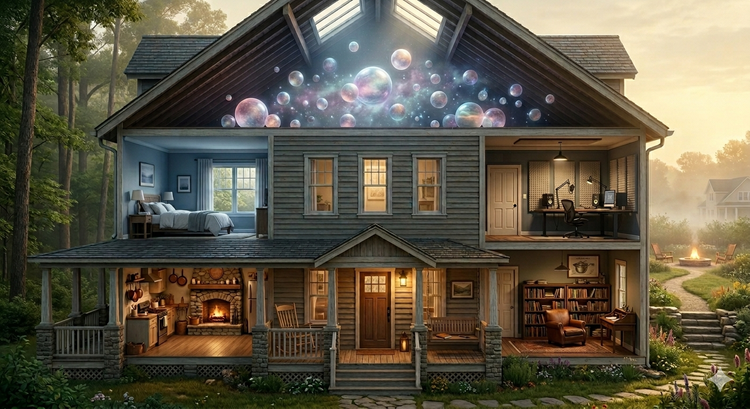
The house I keep coming back to has five rooms. Not as a framework. Not as a system to implement. Just — as a way of thinking about where you actually are at any given moment and whether you're letting yourself be there.
The Kitchen is where you stay human. The daily, unglamorous, load-bearing work of keeping a life running. The hard conversation. The apology. The lunch packed without anyone noticing. The kitchen doesn't ask you to perform. It asks you to show up and do the thing directly in front of you. Not the thing from yesterday. Not the thing you're dreading tomorrow. Just this. Presence here is the most ordinary and the most necessary thing at the same time.
The Living Room is where you listen. Not to respond, not to fix, not to already be forming your answer while someone is still mid-sentence. Just — witness. Be with. This is harder than it sounds if you've spent years in the factory where every conversation is a transaction and listening is just the pause between your talking. The living room asks you to put that down. It's where relationships actually live — not in the grand gestures but in the unhurried ordinary hours.
The Study is slow. Deliberately, stubbornly slow. It's where the raw material of your life — your experiences, your half-formed questions, your ideas that haven't earned their shape yet — gets to sit and breathe until something emerges. Most people have lost access to their interior study. Not for lack of space but because the moment a thought begins to form they've already reached for their phone. The study requires you to be bored for long enough that something interesting surfaces. That's not inefficiency. That's the whole point.
The Porch is where you meet the world without performing for it. There's a difference between a porch and a stage. A stage has lights pointed at you. A porch has light coming from inside the house. One is constructed. One is just — what's true about you, visible from the street. The best version of anything you make or say or share comes from the porch. Not manufactured. Just lit from within.
The Garden is the one I almost didn't write about because it's the hardest to protect. The garden is private. It's the part of your life that is not for anyone else. Not for content or output or growth you can report back on. It's where you play, where you make things that are terrible and that you never show anyone, where you are completely and entirely off the record. The moment you put a camera in a garden it stops being one. It becomes a stage. And the garden is where you remember who you are when no one is watching. If it's been a long time since you've had one — that's where to start.
I want to be honest about something before I close this.
I am not writing from the other side of this. I'm not a man who has mastered the architecture of his own life and is now passing the blueprints along. I'm someone who stood in a new room recently and immediately started renovating it before he'd felt the light.
That's still me. Most days.
But I've started noticing something. Small moments — genuinely small, almost embarrassingly small — where I catch myself actually in the room I'm in. Not planning the next one. Not improving this one in my head. Just here. In this specific light. With this specific quiet or this specific ache.
And it doesn't feel like achievement when that happens.
It feels like relief.
Like putting something down that I'd been carrying so long I forgot it had weight.
That's what I think we're actually after. Not the optimized life. Not the perfectly ordered house with every room in its right place.
Just — occasional relief. The brief, ordinary miracle of being somewhere without immediately needing it to be somewhere else.
That's available right now. Not after the next transition. Not when things settle. Not when the system is finally right.
Right now. In whatever room you're actually standing in.
Even if you're already mentally renovating it.
You're allowed to put the hammer down.
Story House is a publication about storytelling, presence, and the long invisible work of building a life worth narrating. If this found you at the right moment, share it with someone who might need it too.

Member discussion