When the Wheels Stop Spinning
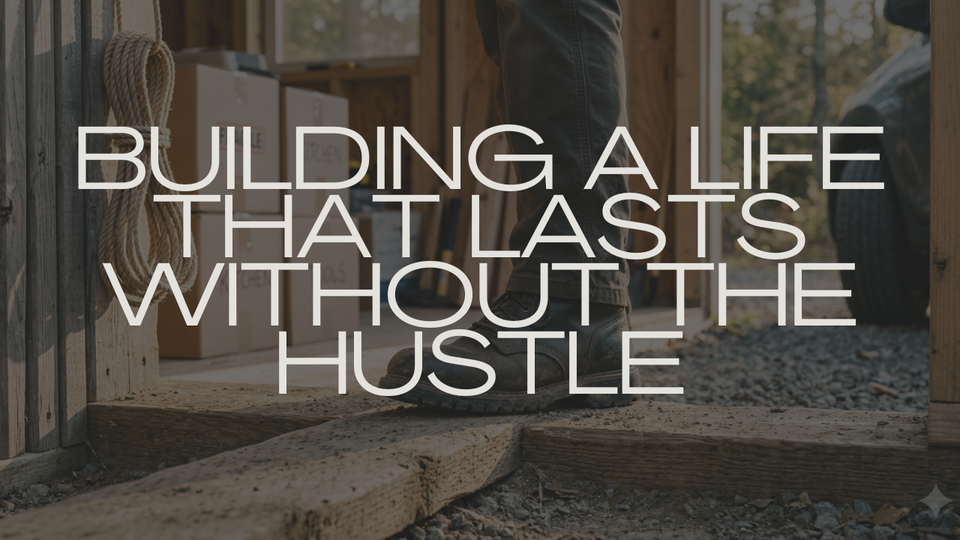
We talk a lot about moving forward. We rarely talk about what it actually feels like at the start of a move—when the boxes are still half-open, the rooms haven't learned your footsteps, and the light hits the windows at angles you haven't yet figured out how to live inside of.
I’ve just moved my family across the state to Clayton. New walls, new echoes, and new versions of ordinary sounds. The way a door closes, the way the heat kicks on at night—everything familiar is wearing a slightly different face.
In the middle of that transition, there is a voice. It’s not a mean voice, but it is an urgent one. It says, "Keep pace. Don’t fall behind. The world didn’t pause for your boxes."
I recorded a video reflection on this specific tension—the difference between forcing a result and finding true traction—from the middle of my still-unpacked living room. You can watch or listen to that below.
Watch: Building a Life That Lasts Without the Hustle
(If this resonates, I’d love to hear your thoughts in the YouTube comments—it helps me understand which parts of this new house we’re building together are landing with you.)
Force vs. Traction
Think about a car stuck in the mud. The human instinct is to floor it. You want out of the mess; you want the engine revving and the wheels spinning so it feels like something is happening. But we know the result: the tires spin, the mud flies, the engine screams, and you’ve only succeeded in digging a deeper hole.
That is Force.
Force happens when we’re afraid that stillness looks like failure. It feels like momentum, but underneath the noise, there is no contact between the tire and the road. Traction is something else entirely. Traction is quiet. It’s that moment when the wheel stops spinning and you feel the grip of solid ground.
The Prepared Environment
As a father, I’ve been shaped by the Montessori pillar of the Prepared Environment. The core is deceptively simple: You don’t force a child to learn. You prepare the room so specifically that learning becomes the natural outcome of being present.
Lately, I’ve been asking what it would mean to prepare that kind of environment for my own creative life. Not to "optimize" it, but to gently ask:
- Is this space ready for the person I’m becoming? * Is there enough quiet for a new idea to find its footing? ### Honoring the Threshold
The Threshold is the part we usually skip. It’s that mandatory clearing where you consciously set down what you’ve been carrying before stepping into the next thing.
In our new home, I’m letting some boxes sit a little longer. I’m watching where the light hits the walls before deciding where things go. I’m sitting with the "not knowing yet" without immediately converting it into a plan.
If you are in a transition right now—a move, a beginning, or just an unnamed season where everything feels unresolved—I’m not going to tell you to push through it. I’m going to tell you to look at the ground you’re standing on.
If the mud is still wet, give yourself permission to stop. Let the ground dry. Traction will come.
I’ll see you in the next room.



Member discussion